
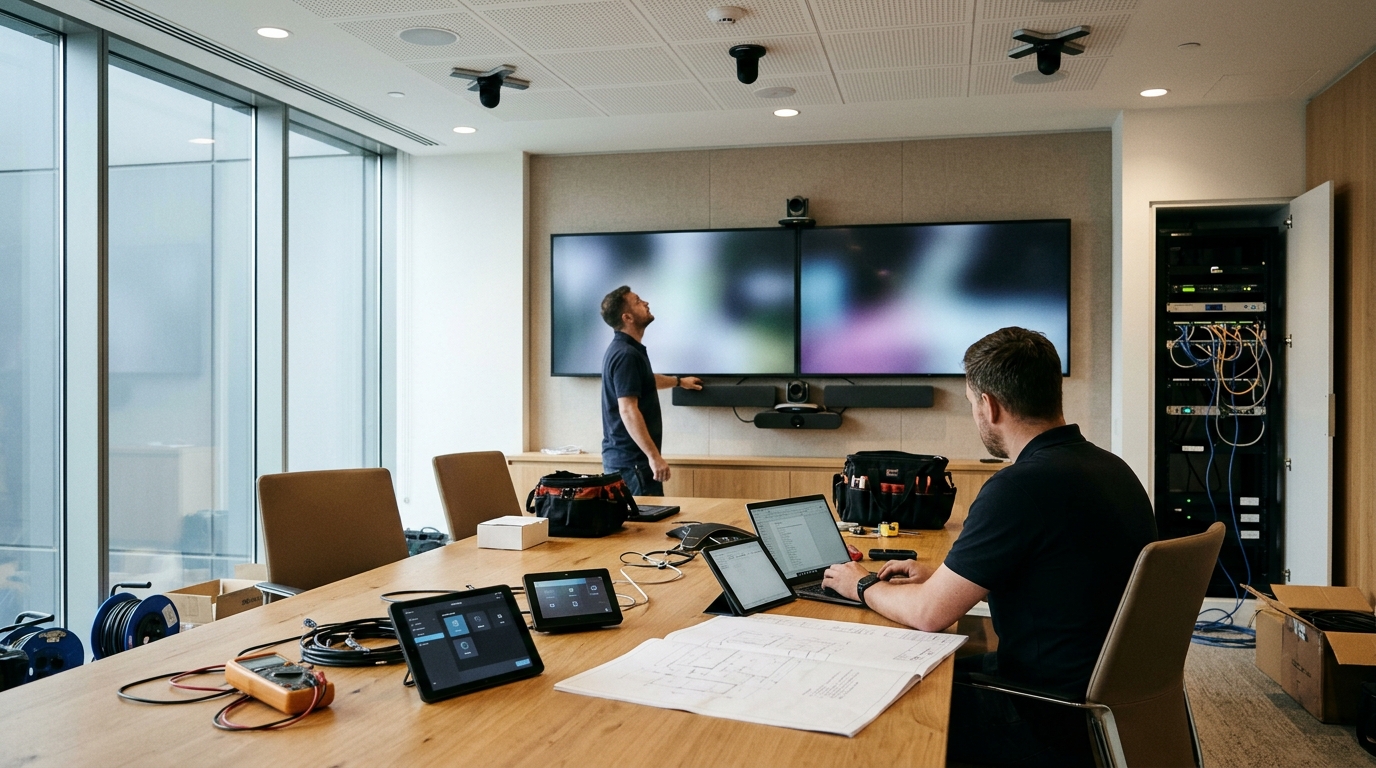
Engineering hours in an audio visual quote reflect the time required for design, programming, and testing. Realistic hours depend on room complexity, system integration depth, and the integrator's methodology. To validate them, compare the proposed hours against the number of rooms, the specific control logic required, and the vendor's documented design process. A transparent breakdown separates standard configuration from custom programming, allowing you to assess whether the labor cost aligns with the actual technical scope of your conference spaces.
Understanding the Components of AV Engineering Labor
Engineering labor is not a single monolithic cost; it is a composite of distinct technical tasks. In a commercial setting, this typically includes site surveys, system design, control programming, and on-site commissioning. Each of these phases requires specific skill sets and time allocations that vary based on the technology stack. For example, a simple video conferencing room requires different engineering effort than a room with complex audio processing and multi-display control.
Design and Documentation
Design hours cover the creation of single-line diagrams, control logic flowcharts, and network topology maps. This phase ensures that the physical installation matches the logical requirements of the system. If a quote includes high design hours for a standard room, it may indicate a lack of templated processes or an overly complex specification. Conversely, low design hours for a complex room suggest potential gaps in planning that could lead to costly on-site changes.
Programming and Configuration
Benchmarking Hours Against Room Complexity
To determine if engineering hours are realistic, you must benchmark them against the complexity of the specific rooms. A standard conference room with a display, camera, and microphone typically requires a baseline of engineering time for integration and testing. However, adding features like room scheduling integration, advanced audio echo cancellation, or multi-room control significantly increases the required hours. Buyers should ask for a per-room breakdown to see how the total hours are distributed across different room types.
The Impact of Control Systems
Integration Depth and Network Dependencies
The Role of Site Surveys and Pre-Installation Analysis
Accurate engineering estimates rely on precise site data. A comprehensive site survey involves measuring room dimensions, identifying power and data drop locations, and assessing acoustic properties. This data is used to calculate signal loss, determine cable lengths, and plan device placement. If a quote assumes a standard site without a detailed survey, the engineering hours may be underestimated. A thorough pre-installation analysis reduces the risk of on-site surprises, which often lead to change orders and increased labor costs.
Documentation and As-Built Drawings
Engineering labor also includes the creation of as-built documentation. These documents reflect the final installed state of the system and are critical for future maintenance and troubleshooting. The time required to produce accurate as-built drawings depends on the complexity of the installation and the quality of the initial design. A professional integrator will include this documentation in their engineering scope, ensuring that your facility team has the necessary information to manage the system long-term.
Evaluating the Integrator's Methodology and Experience
The realism of engineering hours is also a function of the integrator's methodology and experience. Established firms with standardized processes and certified engineers often deliver more predictable outcomes. They use templated designs and automated testing tools to streamline the engineering phase. In contrast, smaller or less structured firms may rely on ad-hoc methods, which can lead to variable hour estimates. When evaluating a quote, consider the integrator's track record with similar projects and their approach to quality assurance.
Certifications and Standards
Industry certifications, such as AVIXA CTS or BICSI RCDD, indicate that the engineers have met specific competency standards. These certifications ensure that the design and programming follow best practices. While certifications do not guarantee a specific number of hours, they provide confidence in the quality of the work. An integrator with certified engineers is more likely to produce a robust and maintainable system, which can reduce long-term maintenance costs.
Key Takeaways
- Engineering hours should be broken down by task type, including design, programming, and testing.
- Benchmark hours against room complexity, considering the number of control points and integration depth.
- Site surveys and pre-installation analysis are critical for accurate engineering estimates.
- The integrator's methodology and experience significantly impact the efficiency of the engineering phase.
- As-built documentation is a standard part of engineering labor and is essential for long-term system management.
- Clarify the boundary between AV and network engineering to avoid double-billing or missed dependencies.
- Industry certifications provide confidence in the quality and standards of the engineering work.
Frequently Asked Questions
What is the typical range of engineering hours for a standard conference room?
There is no single standard, as hours vary by complexity. However, a basic room with a display and camera might require 4 to 8 hours for design and programming, while a complex room with advanced audio and control could require 15 to 25 hours. The key is to ensure the hours align with the specific features and integration requirements of your room.
How do I know if the engineering hours are inflated?
Inflated hours often appear when the quote lacks a detailed breakdown. If the engineering cost is a large percentage of the total project cost without a clear justification for the time spent, it may be inflated. Request a line-item breakdown of design, programming, and testing hours to assess the realism of the estimate.
Does the choice of control system affect engineering hours?
What is the difference between design hours and programming hours?
Design hours cover the planning phase, including creating diagrams and logic flowcharts. Programming hours cover the actual coding and configuration of the control system. Both are essential, but they require different skill sets and time allocations. A realistic quote will distinguish between these two types of labor.
How important is the site survey for engineering accuracy?
The site survey is critical for engineering accuracy. It provides the physical data needed to design the system, such as room dimensions and cable paths. Without a detailed survey, the engineering estimate may be based on assumptions, leading to potential change orders and increased costs during installation.
Should engineering hours include as-built documentation?
Yes, as-built documentation should be included in the engineering scope. These documents reflect the final installed state of the system and are essential for maintenance and troubleshooting. Excluding them from the engineering hours can lead to additional costs later when the documentation is required.
How can I verify the integrator's engineering experience?
Verify experience by reviewing case studies of similar projects and checking for industry certifications. Ask for references from clients with comparable conference room installations. An integrator with a strong track record and certified engineers is more likely to provide realistic and efficient engineering services.
Conclusion
Validating engineering hours in an AV quote requires a detailed understanding of the tasks involved and the complexity of your conference rooms. By breaking down the labor into design, programming, and testing components, you can assess whether the estimate aligns with the technical scope. Superior Communication Services provides transparent engineering processes, ensuring that every hour is accounted for and aligned with your project's specific needs. To discuss your conference room AV requirements and receive a detailed engineering breakdown, contact our team. Learn more: Contact Us Superior Communication.