

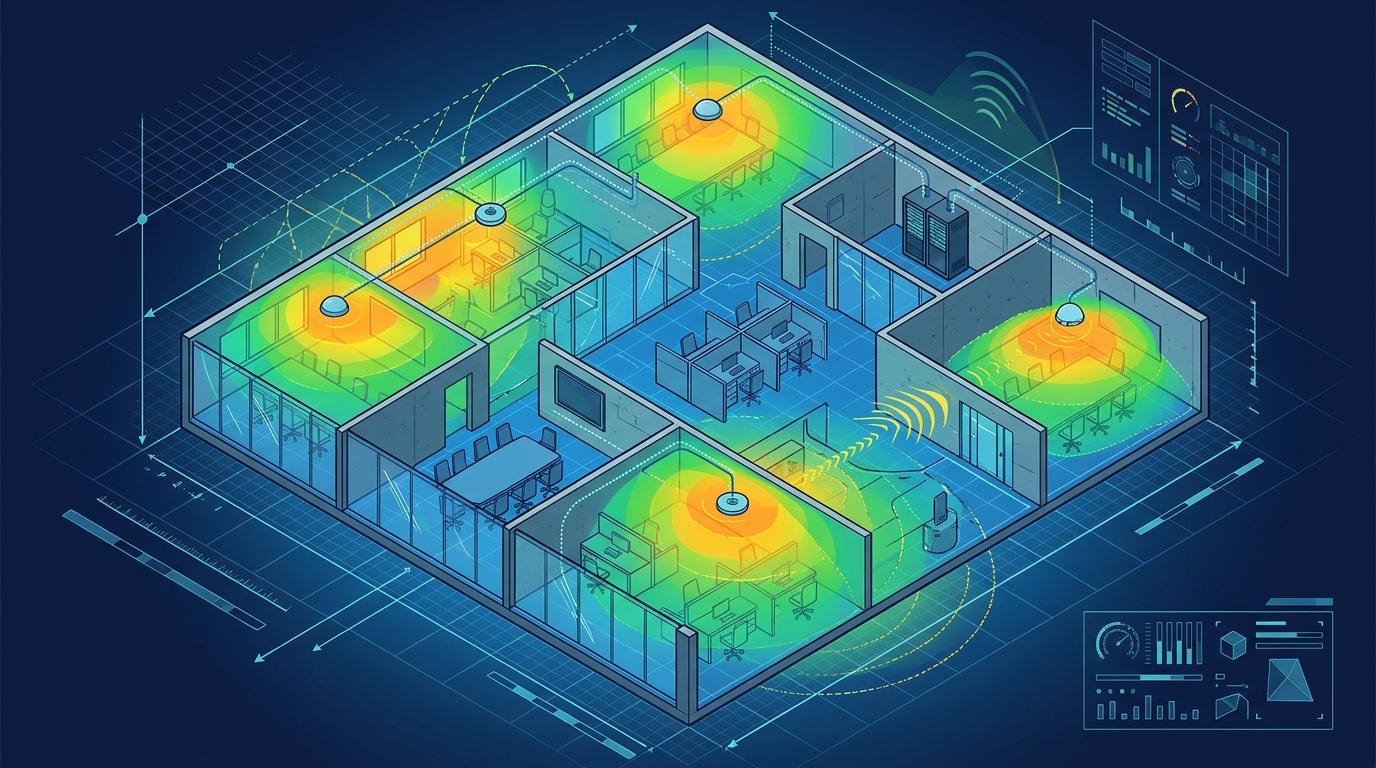
iBwave RF modeling is a predictive simulation process that maps signal strength and coverage before physical installation. It allows engineers to visualize how radio waves interact with office structures, ensuring that a Distributed Antenna System (DAS) meets carrier requirements. By using this software, integrators can optimize antenna placement and power levels, reducing the risk of coverage gaps and costly on-site adjustments during the final build phase.
The Role of Predictive Modeling in DAS Projects
Traditional trial-and-error methods for wireless coverage are inefficient and often lead to over-engineering or dead zones. RF modeling is the computational process of simulating electromagnetic wave propagation within a specific environment. In the context of an office DAS, this involves importing architectural floor plans into the iBwave platform to create a digital twin of the facility. This digital representation allows engineers to test various antenna configurations virtually. The primary goal is to predict the Received Signal Strength Indicator (RSSI) at every point in the building. By identifying potential interference or weak spots before construction begins, the design team can refine the layout to ensure consistent connectivity for all users.
Key Components of an iBwave Simulation
Accurate modeling relies on precise input data. The simulation requires detailed information about the physical environment, including wall materials, ceiling heights, and the presence of metal or glass. Attenuation is the reduction in signal strength as it passes through obstacles, and iBwave calculates this based on material properties. Engineers must assign specific attenuation values to different building elements. For example, a concrete wall attenuates signal differently than a drywall partition. Additionally, the model must account for the specific frequency bands being used, such as 700 MHz, 1900 MHz, or 3.5 GHz. Each band behaves differently in an office environment, with lower frequencies penetrating walls more effectively but requiring more antennas for capacity. The software processes these variables to generate a heat map of predicted coverage.
Interpreting Coverage Heat Maps
Once the simulation is complete, the output is typically a color-coded heat map. Green areas indicate strong signal strength, while red areas show weak coverage or potential dead zones. Engineers analyze these maps to ensure that the design meets the minimum signal thresholds required by carriers and enterprise standards. A common target for office environments is a signal strength of -65 dBm or better at the user level. If the heat map reveals red zones in high-traffic areas like conference rooms or open workspaces, the engineer must adjust the design. This might involve adding more antennas, changing antenna types, or adjusting the power output of the base stations. The iterative nature of this process ensures that the final design is both efficient and effective.
Validation and Site Surveys
While predictive modeling is powerful, it is not a substitute for real-world validation. Site surveys are field measurements taken to verify the accuracy of the simulation. After the initial design is complete, engineers may perform a pre-installation survey to confirm that the actual building materials match the model's assumptions. Post-installation surveys are also critical to ensure that the physical installation performs as predicted. These surveys involve driving or walking through the facility with a spectrum analyzer or a specialized survey device. The data collected is compared against the iBwave model. If discrepancies are found, the model can be refined, and the physical system can be tuned. This validation step is essential for ensuring that the DAS delivers the promised performance levels.
Benefits for Multi-Site Rollouts
Key Takeaways
- iBwave RF modeling predicts signal coverage before installation, reducing the risk of dead zones.
- Accurate modeling requires detailed input on building materials and frequency bands.
- Coverage heat maps visualize signal strength, guiding antenna placement and power adjustments.
- Site surveys validate the simulation, ensuring the physical system meets design targets.
- Predictive modeling supports scalable, consistent designs for multi-site DAS deployments.
- Iterative refinement of the model based on survey data improves final system performance.
Frequently Asked Questions
What is iBwave RF modeling?
iBwave RF modeling is a software-based simulation that predicts how radio frequency signals will propagate within a building. It uses architectural data and material properties to estimate signal strength at various points, helping engineers design an effective DAS.
Why is RF modeling important for office DAS design?
RF modeling is important because it allows for the optimization of antenna placement and power levels before installation. This reduces the likelihood of coverage gaps and ensures that the system meets carrier and enterprise performance requirements.
What data is needed for an accurate iBwave simulation?
An accurate simulation requires detailed floor plans, information on building materials (such as wall and ceiling types), and the specific frequency bands to be used. It also benefits from knowledge of the expected user density and device types.
How does iBwave handle different frequency bands?
iBwave allows engineers to simulate multiple frequency bands simultaneously. Each band is modeled with its own propagation characteristics, such as attenuation through walls. This helps in designing a DAS that supports both coverage and capacity across different carriers.
Can iBwave modeling replace site surveys?
No, iBwave modeling cannot replace site surveys. While it provides a strong predictive baseline, site surveys are necessary to validate the model against real-world conditions and to fine-tune the system after installation.
How does modeling help with multi-site projects?
Modeling helps with multi-site projects by enabling the creation of standardized design templates. These templates can be adapted for different locations, ensuring consistency in performance and simplifying the management of a large-scale deployment.
Partnering with Expert Integrators
Designing a robust office DAS requires more than just software; it demands experienced engineering and a deep understanding of carrier requirements. Superior Communication Services specializes in wireless infrastructure, providing end-to-end solutions from design to installation. Our team leverages advanced modeling tools to ensure that your DAS delivers reliable, high-performance coverage. Whether you are planning a single office or a national rollout, we are committed to delivering a seamless wireless experience. To discuss your project needs, contact our team.