

Professional enterprise WiFi design involves a rigorous, data-driven process that begins with a detailed site survey and ends with a validated, scalable network architecture. It is not simply about placing access points in a grid; it is about mapping signal propagation against physical obstructions, user density, and application requirements. Superior Communication Services approaches this by treating wireless infrastructure as a critical utility, ensuring that every square foot of a commercial building delivers consistent, secure, and high-speed connectivity.
The Foundation of Site Surveys and Heatmapping
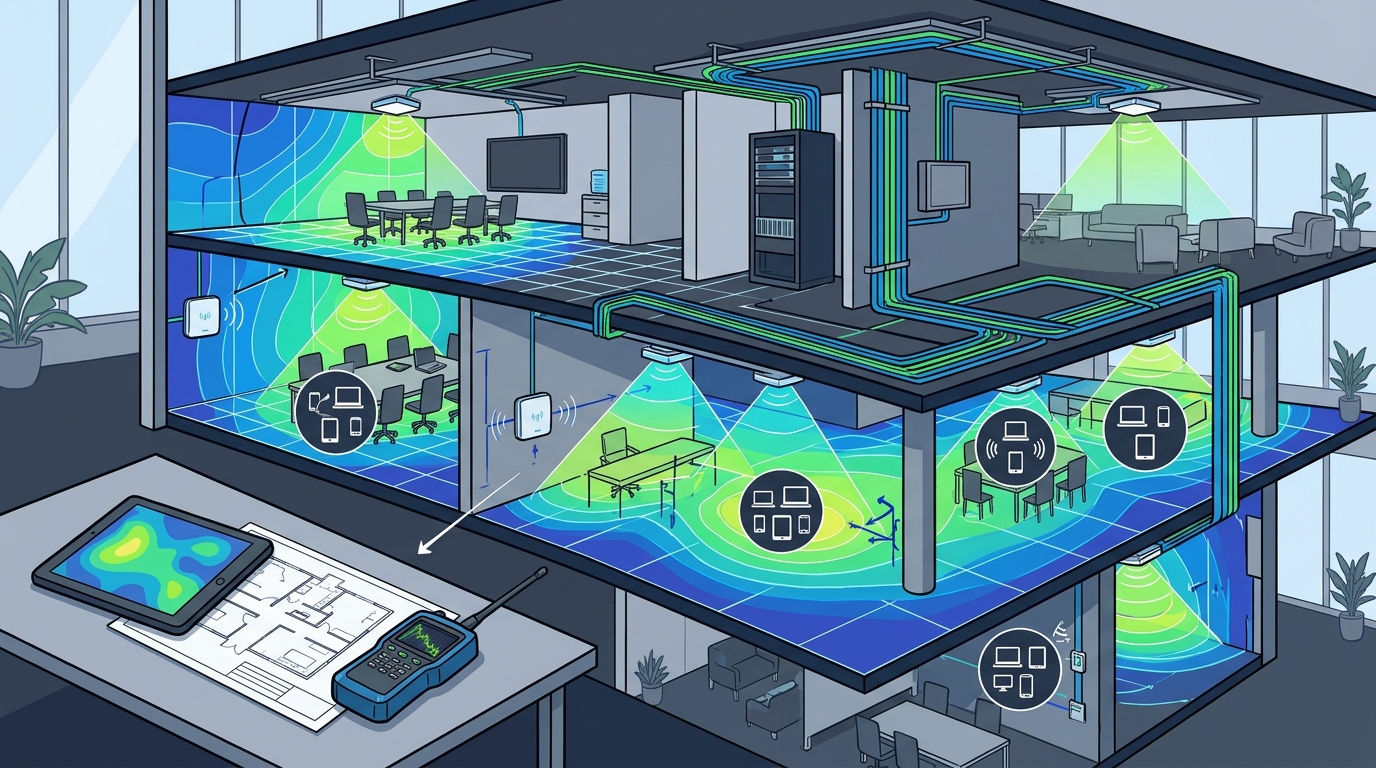
The first phase of any professional design is the site survey. This is not a guesswork exercise. Engineers use specialized software to create predictive heatmaps that model how radio frequency signals will behave in a specific environment. Enterprise WiFi design is the process of translating physical space into a digital coverage map. This map identifies dead zones, interference sources, and optimal access point locations before a single cable is pulled.
In commercial buildings, materials like concrete, steel, and glass significantly attenuate signals. A generic design might place access points every 50 feet, but a professional design accounts for the specific RF environment. For example, a building with heavy metal framing requires a different antenna orientation and power setting than a building with drywall partitions. By analyzing these variables, designers ensure that the network can handle the specific load of the space, whether it is a quiet office or a crowded conference center.
Bandwidth Planning and User Density Analysis
Coverage is only half the equation; capacity is the other. A network can have perfect signal strength but still fail if it cannot handle the number of concurrent users. Professional design involves a deep analysis of user density and application types. User density analysis is the calculation of how many devices will connect to a single access point at peak times. This metric dictates the number of access points required to maintain a healthy client-to-AP ratio.
Security Architecture and Network Segmentation
Security is a non-negotiable component of enterprise WiFi design. Modern networks must protect against a wide range of threats, from rogue access points to advanced persistent threats. Network segmentation is the practice of dividing a network into smaller, isolated subnets to limit the spread of security breaches. In a professional design, guest networks, IoT devices, and corporate user networks are strictly separated. This ensures that a compromised IoT device cannot access sensitive corporate data.
Furthermore, the design must incorporate robust authentication methods, such as 802.1X, to verify every device that connects to the network. This level of security is critical for commercial buildings that house sensitive intellectual property or customer data. By integrating security into the design phase, rather than bolting it on later, organizations can build a resilient network that is difficult for attackers to penetrate.
Scalability and Future-Proofing the Infrastructure
Technology evolves rapidly, and a WiFi design that works today may be insufficient in three years. Professional design focuses on scalability to accommodate future growth. This includes planning for additional access points, upgrading to newer WiFi standards, and ensuring that the backhaul infrastructure can support increased bandwidth demands. Scalability in network design is the ability to expand capacity and coverage without a complete system overhaul.
For commercial buildings, this might mean reserving space in ceilings for future access points or ensuring that the structured cabling can support higher data rates. By designing with the future in mind, organizations can avoid costly rip-and-replace projects. This forward-thinking approach ensures that the network remains relevant and efficient as new technologies and applications emerge.
Validation and Post-Deployment Testing
If any issues are found, such as weak signal in a specific corner or poor roaming between access points, the design is adjusted and re-tested. This iterative process ensures that the final network is not just installed, but optimized for real-world use. It provides peace of mind that the investment in the network will deliver the expected results.
Key Takeaways
- Professional design starts with a detailed site survey and predictive heatmapping, not guesswork.
- User density analysis is critical to ensure the network can handle the actual number of devices.
- Network segmentation is essential for isolating guest, IoT, and corporate traffic for security.
- Scalability planning prevents the need for costly future overhauls as technology evolves.
- Post-deployment validation ensures the installed network meets the original design goals.
- Working with a certified integrator ensures that the design is tailored to the specific building environment.
Frequently Asked Questions
How long does an enterprise WiFi design project take?
The timeline depends on the size and complexity of the building. A small office might take a few weeks, while a large multi-story commercial building could take several months. The design phase itself usually takes a few weeks, followed by the installation and validation phases.
Do I need a new WiFi standard for my building?
It depends on your current infrastructure and future needs. If your existing hardware is older than five years, upgrading to a newer standard like WiFi 6 or 6E may be beneficial for improved capacity and efficiency. A professional assessment can help determine if an upgrade is necessary.
Can I design my own enterprise WiFi network?
While it is possible to use software to create a basic design, professional design involves deep expertise in RF physics, security, and network architecture. For commercial buildings, it is recommended to work with a certified integrator to ensure the network is secure, scalable, and optimized for performance.
What is the difference between coverage and capacity?
Coverage refers to the area where the WiFi signal is present. Capacity refers to the amount of data the network can handle at any given time. A network can have full coverage but low capacity, leading to slow speeds when many users are connected. Professional design balances both.
How does security factor into the design?
What is the role of a site survey in the design process?
A site survey is a critical step that involves collecting data about the physical environment. This data is used to create predictive heatmaps and identify potential interference sources. It ensures that the design is based on real-world conditions rather than assumptions.
Partnering with a Certified Integrator
Designing a professional enterprise WiFi network is a complex task that requires specialized skills and tools. Superior Communication Services brings over 50 years of combined industry experience to every project. Our team of certified engineers uses advanced software to perform comprehensive site surveys and wireless designs based on the specific needs of your business. We do not just install hardware; we design a solution that is tailored to your environment, ensuring maximum performance and coverage. To start planning your next project, for a consultation.