

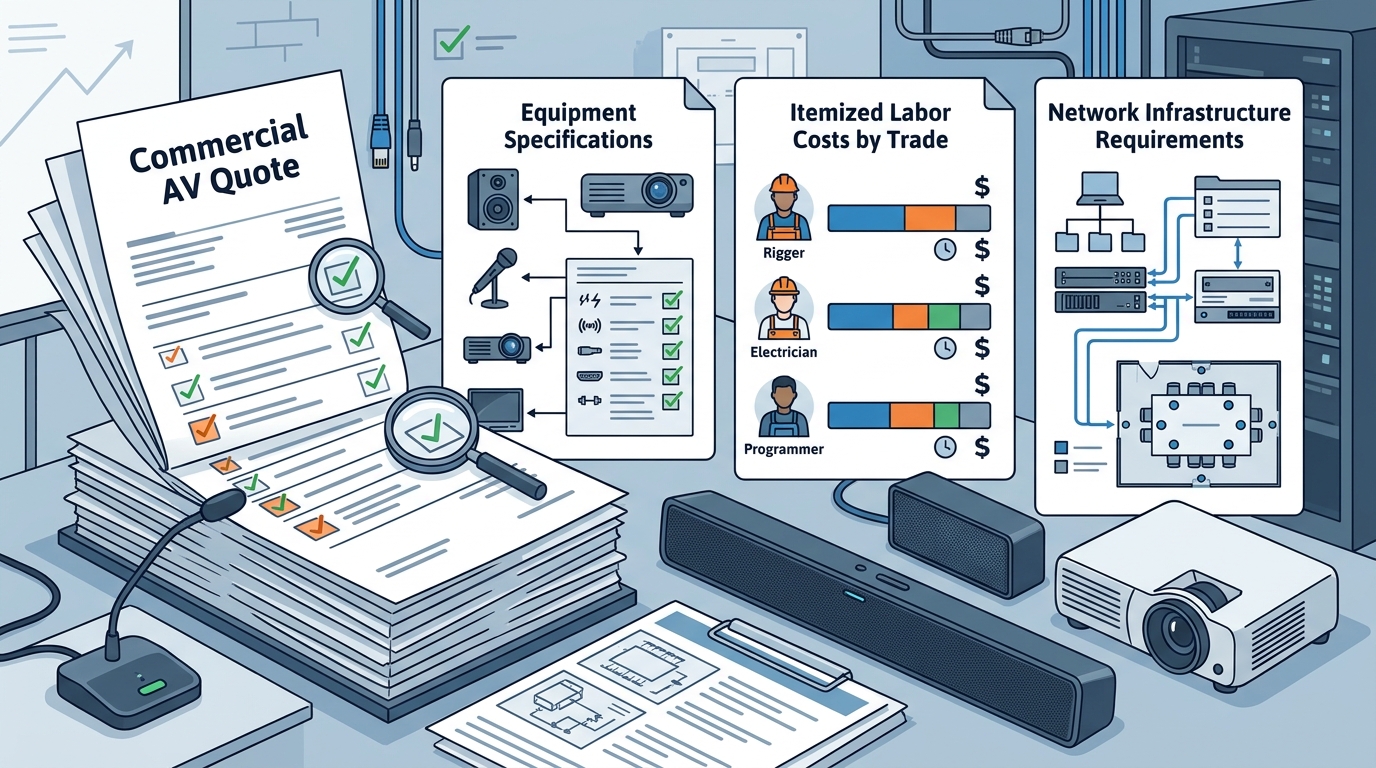
When evaluating a commercial audio visual installation quote, buyers must verify that equipment specifications match their operational needs, labor costs are itemized by trade, and network infrastructure requirements are explicitly defined. This guide details the seven critical areas where quotes often hide gaps or ambiguities. We break down how to audit equipment specs, labor breakdowns, and commissioning procedures to ensure your investment delivers the intended return. By understanding these technical and contractual nuances, you can avoid costly post-installation surprises and ensure a seamless deployment.
Equipment Specifications
Equipment specifications form the backbone of any AV quote. A generic description like '4K display' is insufficient for a commercial environment. You must verify the exact manufacturer, model number, and serial number of every component. This level of detail ensures that the hardware installed matches the hardware priced. For example, a 75-inch display from a specific manufacturer may have different input lag or brightness levels than a competitor's model, which directly impacts user experience in a conference room.
Resolution and Refresh Rates
Verify that the resolution and refresh rate of displays and video walls meet your content requirements. For digital signage, a 60Hz refresh rate is standard, but for high-motion content, 120Hz may be necessary. Ensure the quote specifies the native resolution of the panel, not just the maximum supported resolution via scaling. This prevents visual artifacts and ensures crisp image quality.
Audio Performance Metrics
Audio equipment requires specific performance metrics. Look for decibel (dB) output levels, frequency response ranges, and signal-to-noise ratios. In open office environments, sound masking systems require specific dB levels to effectively reduce speech intelligibility. Verify that the proposed speakers or emitters are rated for the specific acoustic environment of your space.
Labor Breakdown
Labor costs are often the most opaque section of an AV quote. A lump sum for 'installation' hides the true cost of the work. You should demand a detailed labor breakdown that separates design, programming, physical installation, and testing. This transparency allows you to compare quotes from different integrators on an apples-to-apples basis. It also helps you understand where the value is being added.
Trade Separation
Ensure the quote distinguishes between low-voltage technicians and general construction labor. Low-voltage work, such as cabling and device mounting, requires specialized skills and certifications. General construction labor, such as drywall or painting, should be billed separately or excluded from the AV scope. Mixing these trades can lead to billing discrepancies and project delays.
Travel and Overtime
For multi-site projects, verify how travel time and overtime are calculated. Does the quote include travel days? Is there a cap on overtime hours? These details can significantly impact the final invoice, especially for national rollouts. A clear labor breakdown protects you from unexpected cost overruns.
Network Infrastructure
Modern AV systems are network-dependent. A quote that ignores network infrastructure is a recipe for failure. You must verify that the quote includes the necessary network switches, access points, and cabling to support the AV devices. This includes both the physical layer For additional details, see copper and fiber. and the logical layer (VLANs, QoS settings). Without proper network design, AV systems will suffer from latency, packet loss, and poor performance.
Bandwidth and Latency Requirements
Verify that the network design meets the bandwidth and latency requirements of your AV applications. Video conferencing, for instance, requires low latency and high bandwidth to ensure clear audio and video. Sound masking systems require reliable network connectivity to function correctly. Ensure the quote includes a network design document that specifies these requirements.
Integration with Existing Infrastructure
Commissioning Procedures
Commissioning is the process of testing and validating the installed AV system. It is not just a formality; it is a critical step that ensures the system works as intended. You should verify that the quote includes a detailed commissioning plan. This plan should outline the specific tests that will be performed, the acceptance criteria, and the sign-off process. A robust commissioning procedure protects your investment and ensures a smooth handover.
Functional Testing
Performance Validation
Performance validation goes beyond functional testing. It verifies that the system meets the performance metrics specified in the design. For example, it may include measuring sound pressure levels in a conference room or testing video latency in a digital signage network. This step ensures that the system delivers the intended user experience.
Warranty Terms
Warranty terms define the level of support you will receive after the installation is complete. You should verify the duration and scope of the warranty. Does it cover parts, labor, or both? Is it a manufacturer's warranty or an integrator's warranty? A comprehensive warranty provides peace of mind and protects your investment. It also ensures that you have access to technical support when you need it.
Response Times and SLAs
Verify the response times and service level agreements (SLAs) included in the warranty. How quickly will the integrator respond to a service request? What is the target resolution time? These metrics are critical for business continuity. A clear SLA ensures that you know what to expect when a problem arises.
Extended Support Options
Consider extended support options beyond the initial warranty period. These options may include preventive maintenance, software updates, and hardware replacements. Extended support ensures that your AV system remains up-to-date and functional over its lifecycle. It also simplifies budgeting for ongoing maintenance costs.
Site Assumptions
Site assumptions define the conditions under which the installation will take place. You should verify that the quote includes a detailed site survey. This survey should document the physical environment, including ceiling heights, power availability, and network access. It should also identify any potential obstacles or challenges. A thorough site survey ensures that the quote is accurate and that the installation can proceed smoothly.
Power and Grounding
Verify that the site survey includes an assessment of power and grounding. AV equipment requires stable power supply and proper grounding to function correctly. The survey should identify any power quality issues and recommend solutions. This prevents equipment damage and ensures reliable operation.
Environmental Conditions
Documentation Deliverables
Documentation deliverables are the final output of the AV project. You should verify that the quote includes a comprehensive documentation package. This package should include as-built drawings, test reports, user manuals, and warranty documentation. These documents are essential for ongoing maintenance and troubleshooting. They also provide a record of the project for future reference.
As-Built Drawings
As-built drawings show the final layout of the AV system, including cable routes, device locations, and network connections. These drawings are critical for future modifications or expansions. They provide a visual reference for the installed system. Ensure that the as-built drawings are accurate and up-to-date.
Test Reports
| Verification Area | Key Items to Check | Common Pitfalls |
|---|---|---|
| Equipment Specs | Model numbers, resolution, dB levels | Generic descriptions, missing metrics |
| Labor Breakdown | Trade separation, travel, overtime | Lump sums, hidden travel costs |
| Network Infrastructure | Switches, VLANs, QoS settings | Ignored network requirements |
| Commissioning | Functional tests, performance validation | Missing acceptance criteria |
| Warranty Terms | Duration, scope, SLAs | Unclear response times |
| Site Assumptions | Power, grounding, environment | Inaccurate site surveys |
| Documentation | As-builts, test reports, manuals | Missing or outdated documents |
Key Takeaways
- Always verify exact equipment model numbers and performance metrics in the quote.
- Ensure the quote includes a comprehensive network infrastructure design.
- Require a detailed commissioning plan with clear acceptance criteria.
- Review warranty terms for duration, scope, and service level agreements.
- Verify that the quote is based on a thorough site survey.
- Request a complete documentation package including as-built drawings and test reports.
- Choose an integrator with a proven track record in your industry.
Frequently Asked Questions
What is the most common mistake buyers make when reviewing an AV quote?
The most common mistake is accepting generic equipment descriptions without verifying exact model numbers and performance metrics. This can lead to receiving hardware that does not meet your operational needs.
How should labor costs be structured in an AV quote?
Labor costs should be itemized by trade, separating low-voltage technicians from general construction labor. Travel and overtime costs should also be clearly defined.
Why is network infrastructure important in an AV quote?
Modern AV systems are network-dependent. A quote that ignores network infrastructure can lead to performance issues such as latency and packet loss.
What should be included in a commissioning plan?
A commissioning plan should include functional tests, performance validation, and clear acceptance criteria. It should also outline the sign-off process.
How long should an AV warranty last?
Warranty duration varies, but a minimum of one year for parts and labor is standard. Extended support options are available for longer coverage.
What are site assumptions in an AV quote?
Site assumptions define the conditions under which the installation will take place, including power, grounding, and environmental factors. They are based on a site survey.
Why are documentation deliverables important?
Documentation deliverables, such as as-built drawings and test reports, are essential for ongoing maintenance and troubleshooting. They provide a record of the project.
Conclusion
Verifying a commercial audio visual installation quote requires a detailed and methodical approach. By focusing on equipment specifications, labor breakdowns, network infrastructure, commissioning procedures, warranty terms, site assumptions, and documentation deliverables, you can ensure that your investment delivers the intended return. Superior Communication Services provides comprehensive audio visual design and installation services, ensuring that every component is tested and validated. Our team of certified technicians works with you to create a turnkey solution that meets your specific needs. To plan your next project, for a detailed consultation.