

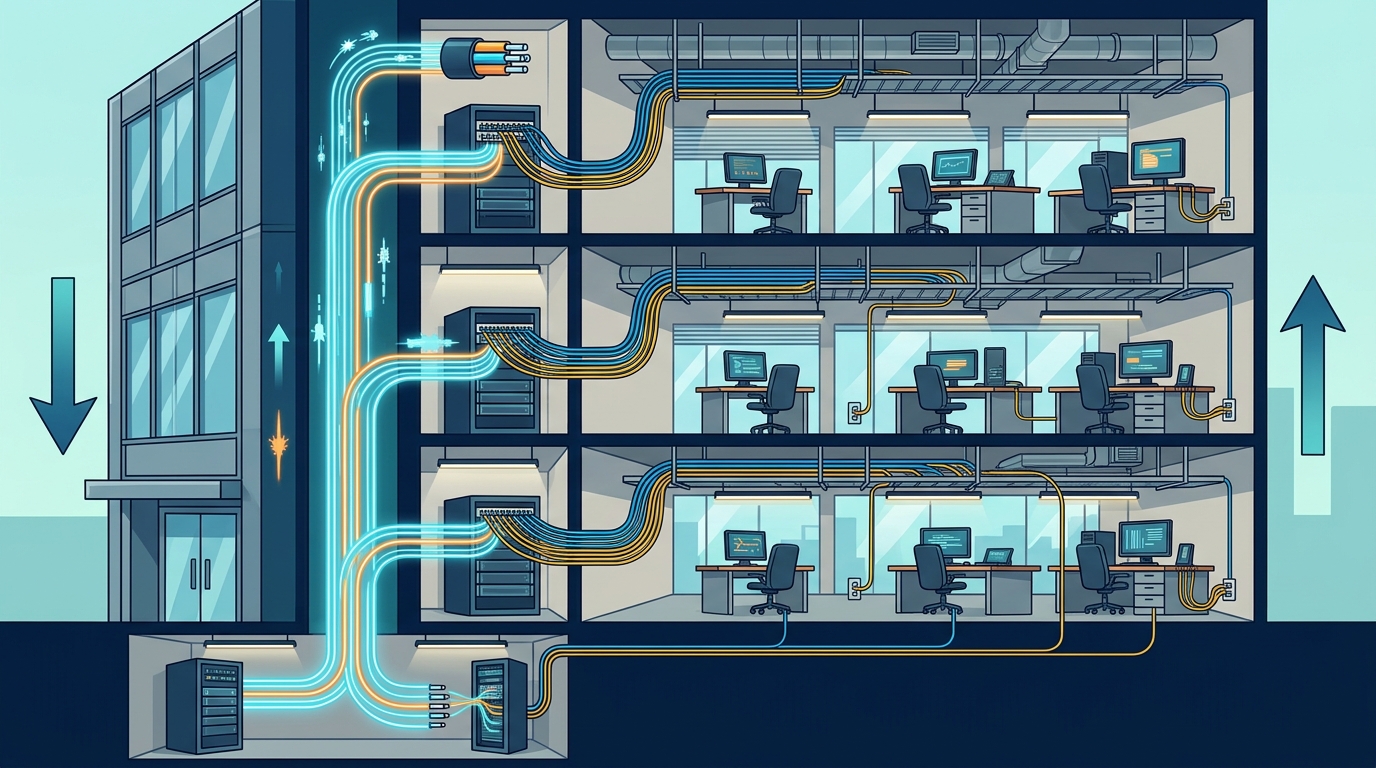
For most new commercial offices, the best approach is a hybrid infrastructure using fiber optic backbone connections and copper horizontal runs. This combination balances high-speed data transfer between floors with cost-effective connectivity to individual workstations. This guide explores the technical specifications, cost implications, and design strategies for integrating these two mediums in modern workplace environments. For additional details, review the About Us 8211 Superior.
Copper Horizontal Runs
Copper cabling remains the standard for connecting end-user devices to the network. Copper horizontal cabling is the physical layer that connects network switches to workstations, IP phones, and access points. In a new office build, this typically involves Category 6 or Category 6A twisted pair cables. These cables are terminated at patch panels in the telecommunications room and run to wall outlets or ceiling drops. For additional details, review the Our partners 8211 Superior.
Performance and Distance Limits
Copper cables have a strict distance limitation of 100 meters (approximately 328 feet) for data transmission. This limit is defined by industry standards to ensure signal integrity. If a workstation is located further than this distance from the nearest telecommunications room, a fiber extension or an intermediate switch is required. For most open-plan offices, the 100-meter limit is sufficient to cover the majority of the floor space from a central or distributed telecom room.
Category 6A cabling supports 10 Gigabit Ethernet over the full 100-meter distance. This makes it ideal for high-density environments where multiple devices connect to a single switch port. The shielding in Category 6A cables also provides better protection against electromagnetic interference, which is common in buildings with heavy HVAC systems or industrial equipment.
Cost and Installation Factors
Superior Communication Services specializes in network cabling solutions that include both copper and fiber infrastructure. Our engineers design the layout to minimize cable length while maximizing coverage. This approach ensures that every horizontal run is within the optimal performance range.
Fiber Backbone Connections
Fiber optic cabling serves as the high-speed highway between different parts of the building. Fiber backbone cabling is the infrastructure that connects telecommunications rooms on different floors or between separate buildings. It uses light pulses to transmit data, which allows for significantly higher bandwidth and longer distances than copper.
Bandwidth and Scalability
Unlike copper, fiber is immune to electromagnetic interference. This makes it ideal for running through buildings with heavy electrical loads. It is also thinner and lighter than copper, which makes it easier to route through tight spaces and vertical risers. For multi-story buildings, fiber is the preferred medium for vertical backbone connections.
Distance and Reliability
Fiber optic cables can transmit data over distances of several kilometers without signal degradation. This makes them suitable for connecting multiple buildings on a campus. In a new office construction, the fiber backbone is typically installed during the rough-in phase of the project. This allows for proper routing through conduits and risers before the ceilings are closed.
Reliability is a key advantage of fiber. The glass core is less susceptible to physical damage than copper, provided it is handled correctly during installation. Once installed, fiber connections are highly stable and require minimal maintenance. This stability is critical for mission-critical applications that cannot tolerate downtime.
Copper vs. Fiber Comparison
The following table summarizes the key differences between copper and fiber optic cabling for new office environments.
| Feature | Copper (Cat 6/6A) | Fiber Optic |
|---|---|---|
| Maximum Distance | 100 meters | 2+ kilometers |
| Bandwidth | Up to 10 Gbps (Cat 6A) | 100 Gbps and higher |
| Interference | Susceptible to EMI | Immune to EMI |
| Cost per Foot | Lower | Higher |
| Termination Complexity | Moderate | High (requires fusion splicing) |
| Primary Use | Horizontal runs to devices | Backbone between rooms/buildings |
Key Takeaways
- A hybrid approach using fiber for the backbone and copper for horizontal runs is the industry standard for new offices.
- Copper cables are limited to 100 meters, which dictates the placement of telecommunications rooms.
- Fiber is essential for connecting multiple buildings or floors with high-speed data links.
- Proper design and certification are critical to ensure performance and reliability.
- Working with an experienced integrator ensures that the cabling infrastructure meets current and future needs.
Frequently Asked Questions
Can I use fiber for all connections in a new office?
While technically possible, using fiber for every horizontal run is rarely cost-effective. Fiber termination is more complex and expensive than copper. Most organizations use fiber for the backbone and copper for the last 100 meters to the device.
What is the difference between single-mode and multi-mode fiber?
Single-mode fiber uses a smaller core and is designed for long-distance, high-bandwidth applications. Multi-mode fiber has a larger core and is suitable for shorter distances within a building. For most office backbones, multi-mode fiber is sufficient, but single-mode is preferred for campus-wide connections.
How many telecommunications rooms do I need?
The number of rooms depends on the size of the floor and the distance to the furthest workstation. Each room should be placed so that no copper run exceeds 100 meters. A professional site survey can determine the optimal number and location of rooms.
Is copper cabling obsolete?
No, copper cabling is not obsolete. It remains the most practical and cost-effective solution for connecting end-user devices. Advances in copper technology, such as Category 6A, continue to improve its performance and longevity.
How long does a fiber installation take?
The duration depends on the size of the project and the complexity of the routing. A small office might take a few days, while a multi-story building could take several weeks. Proper planning and coordination with other trades are essential to stay on schedule.
Do I need to certify my cabling?
Yes, certification is critical. It verifies that each cable run meets the performance standards required for your applications. Certification provides a record of the installation quality and is often required for warranty purposes.
Conclusion
Choosing between copper and fiber optic cabling for a new office is not an either/or decision. The optimal solution is a hybrid design that leverages the strengths of both technologies. Fiber provides the high-speed backbone, while copper delivers reliable connectivity to every workstation. By working with a qualified integrator, you can ensure that your infrastructure is designed for performance, scalability, and long-term value. Contact Superior Communication Services to discuss your cabling needs and receive a tailored design proposal.